I don't use a dozen indicators. I use one — the 44 Simple Moving Average — checked across two timeframes, with a small set of rules that I follow without exception. This page is that exact system, written down properly for the first time.
If you're looking for a "secret indicator" or a strategy that wins every time, this isn't it. What follows is a setup with clear rules, a defined risk on every trade, and an honest account of where it goes wrong — because most strategy explainers online skip that part entirely.
What is the 44 SMA, and why 44?
A Simple Moving Average smooths out price by averaging the closing price over a fixed number of candles. The 44 SMA averages the last 44 candles on whatever timeframe you're looking at.
There's no magic to the number 44 — it isn't derived from some secret formula. It sits in a useful middle ground: short enough to react to the current session's momentum, long enough to filter out the noise of individual candle wicks. Shorter averages (9, 14, 20) whipsaw constantly in choppy markets. Longer ones (50, 100, 200) react too slowly for intraday moves that need to be caught and exited within hours.
I settled on 44 through trial and observation on Nifty 50 and Bank Nifty constituent stocks — it consistently acted as a clean support/resistance line during trending sessions on both the 5-minute and 15-minute charts, which is the combination this entire strategy is built around.
The setup: two timeframes, one signal
This is not a single-chart strategy. You need both the 5-minute and 15-minute charts open side by side, both with the 44 SMA plotted.
On TradingView:
- Open the stock's chart
- Add the Simple Moving Average indicator
- Set the length to 44
- Do this on both a 5-minute and a 15-minute chart for the same stock
The 15-minute chart tells you the broader intraday trend. The 5-minute chart tells you whether the immediate momentum agrees with that trend. You only trade when both agree.
The entry checklist — all 6 must be true
This is the exact checklist I run before entering any trade. I built it into BharatDash's Daily Trade Simulator as a literal pass/fail list, because the moment you skip one of these to "make an exception," that's usually the trade that loses.
1. 15-minute price is above the 44 SMA
The 15-min candle must have closed above the SMA line — not just touched it, closed above it. This is your trend filter. If price is below the 15-min 44 SMA, you don't take long setups, full stop.
2. 5-minute price is above the 44 SMA
Same rule, shorter timeframe. This confirms the immediate momentum agrees with the bigger trend you just checked.
3. The exact candle confirmation
This is the part most people get wrong, and it's the single biggest reason beginners lose money on this setup. It's not enough for price to be "above" the SMA on a chart that's drifting sideways. You need:
- The last two candles are green (bullish, closing higher than they opened)
- Both candles are touching or sitting just above the 44 SMA line — not floating 2% above it, not having already run away from it
If price has already moved a long way above the SMA before you notice it, you've missed the entry. Chasing it from there is exactly how the strategy turns into a losing one. The edge is in catching the bounce off the line, not in joining a move that's already happened.
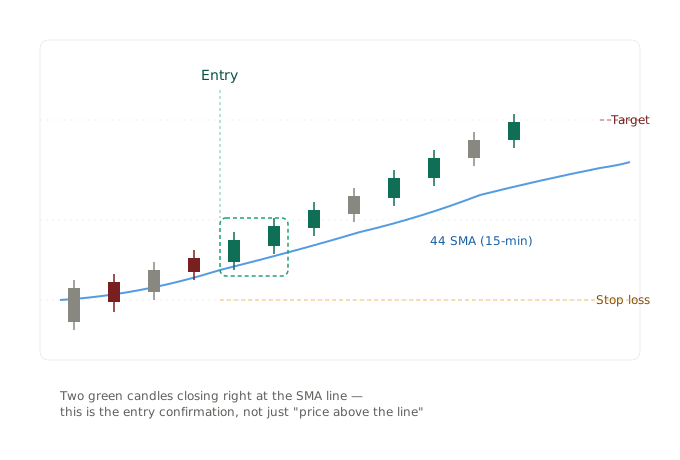
A valid entry: the last two candles are green and sit right at the SMA line. Price then moves favourably toward the target, with a stop loss marked below.
4. Entry is after 9:30 AM
The first 15 minutes of the Indian market (9:15–9:30 AM) are dominated by overnight gap reactions, opening auction unwinds, and algo-driven volatility that has nothing to do with the 44 SMA setup. I do not take entries in this window. Wait for the noise to settle.
5. Target is below the nearest resistance
Check the previous day's high and the most recent swing highs on your chart. Your target needs to sit comfortably below that level — I personally leave at least ₹0.50 of room below a resistance wall, because price often stalls or reverses right at it, and a target placed exactly at resistance frequently doesn't fill.
6. Net P&L is positive after all charges, with R:R of at least 1:1.5
This is where most strategy guides stop short — they show you gross profit and ignore the fact that brokerage, STT, exchange charges, and GST eat into small wins disproportionately. Run the trade through a real brokerage calculator before entering. If the charges wipe out most of your edge, the setup isn't worth taking — even if every other box is checked.
If any single item on this list fails, I don't take the trade. Not "I'll be careful," not "just this once" — I don't take it.
Stop loss: half of my expected profit
Here's the part that surprises people when I explain it. I don't place my stop loss at a fixed percentage, and I don't always place it at the most recent swing low either (though I check that level too, as a sanity check).
My SL is sized at half of what I expect to make on the trade.
If I'm targeting a ₹6 move per share, my stop loss is roughly ₹3 away from entry. This does two things at once:
- It bakes a 1:2 risk-reward ratio directly into the trade structure before I even place the order — I'm never risking more than half of what I stand to gain
- It forces discipline on the target side too — if I can't find a realistic ₹6 move with resistance clearance, I either resize the trade or skip it
I do still sanity-check this against the nearest swing low or recent candle low. If my "half of profit" stop loss would sit above a level where the setup would obviously be invalidated (price breaking back below the SMA, for instance), I widen it slightly to sit just below that structural level instead. The half-of-profit rule is the default; structure can override it when the two disagree.
Target: risk-reward, resistance, and trailing
Three things decide where I book profit, applied in this order:
1. Risk-reward ratio of 1:1.5 to 1:2 minimum. Given my SL is already sized at half my expected profit, this is mostly automatic — but I still confirm the resulting R:R explicitly before entering, never after.
2. Nearest resistance / previous high. The R:R math gives me a target price. I then check whether that price sits below a real resistance level. If the math-derived target is sitting right into a wall, I either take the trade with a slightly reduced target (still within 1:1.5) or skip it if there's no room to work with at all.
3. Trailing the stop loss once the trade is working. If price moves favourably and clears the first resistance level cleanly, I don't always exit at my original target. I trail the SL up — moving it to breakeven once the trade is in meaningful profit, then progressively tightening it behind new swing lows as the move continues. This is how a handful of trades each month turn into bigger wins than the original 1:1.5 plan, without changing the risk I originally accepted.
The mistakes that wreck this strategy
I want to be specific here, because vague warnings like "don't overtrade" aren't useful. These are the three exact ways I've watched this setup fail, including times it's happened to me.
Mistake 1 — Entering too early, before the setup actually confirms.
Seeing price approach the 44 SMA and entering in anticipation, instead of waiting for the candle close confirmation. The market doesn't owe you a bounce just because price is near the line. Wait for the close.
Mistake 2 — Ignoring the exact candle rule and entering on a vague "above the SMA" read.
This is the one I called out earlier, and it's worth repeating because it's the most common failure mode: the chart needs to show the last two candles green and touching the 44 SMA line — not a stock that crossed above the SMA three candles ago and has already run. If you're entering because "it's above the SMA," and not because you can point to two green candles sitting right on the line, you're not trading this strategy — you're trading momentum-chasing, which has a completely different risk profile.
Here are the two most common ways this mistake actually shows up on a chart:
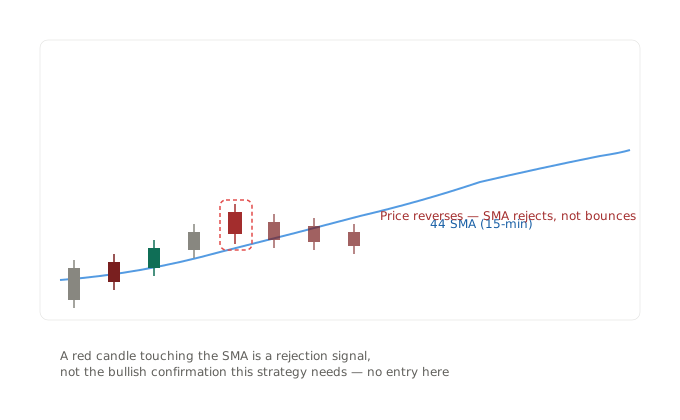
Bad entry #1: a red candle touches the SMA line. This is the market rejecting the line, not bouncing off it. No entry — even though price is technically "near" the SMA.
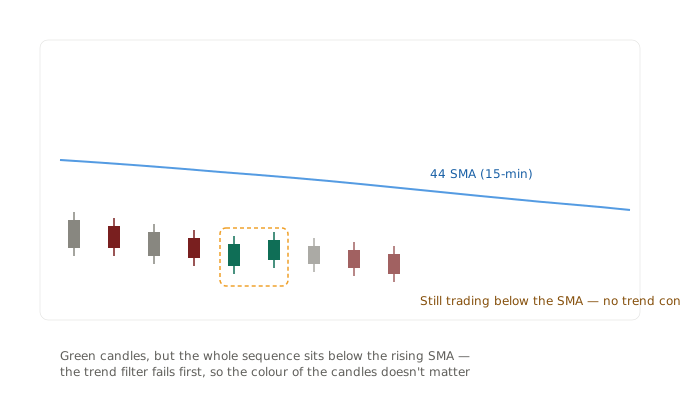
Bad entry #2: the candles are green, but the whole sequence is still below the SMA. The trend filter (price above the SMA) fails first — candle colour doesn't matter if this condition isn't met.
Mistake 3 — Not accounting for brokerage eating small wins.
A ₹150 gross profit on a small quantity trade can shrink to ₹40–50 net after STT, exchange charges, GST, and brokerage — especially on Groww's charge structure, where the ₹20 cap and ₹5 minimum brokerage rules mean smaller trades pay a higher percentage in fees than larger ones. I run every setup through the calculator before entering specifically to catch this. A trade that looks profitable on the chart can be a net loser after charges, and you won't know unless you check.
A real example from my own trading
I've documented an actual trade using this exact setup — BPCL, on Groww, with the real entry, exit, stop loss placement, and the brokerage charges that came out of it. Read the full trade breakdown →
It includes the parts most strategy pages leave out: what the chart actually looked like at entry, what I almost got wrong, and the exact net P&L after every charge — not just the headline gross number.
Try it yourself
Before you take this live, run a few setups through the Daily Trade Simulator. Enter a real entry, target, and stop loss from a stock you're watching, tick through the same 6-point checklist above, and see whether the trade actually clears the bar — including charges — across Groww, Zerodha, Upstox, or Angel One.
If you want a permanent way to track every trade against this exact checklist over time, the Intraday Trade Setup Journal is built around the same system.
Important disclaimer
I am not a SEBI-registered investment advisor or research analyst. Nothing on this page is an attempt to teach trading professionally or to influence anyone to start trading. I am not a financial advisor, and this is not financial advice in any form.
The content here reflects a personal strategy I use for my own intraday trades, written up and shared because I couldn't find this specific setup explained clearly anywhere else — not because I'm claiming any special authority on the subject. Everything described draws on publicly available trading and technical analysis knowledge from across the internet, observed and tested through my own trading, and curated here in one place so readers don't have to piece it together from a dozen different sources themselves.
Trading in the stock market involves real financial risk, including the risk of losing your entire capital. Past performance of any strategy, including this one, does not guarantee future results. Markets are unpredictable, and a setup that has worked in the past can fail at any time without warning.
I take no responsibility for any profit or loss arising from the use of the information on this page. You are solely responsible for your own trading and investment decisions. If you choose to trade, please do your own research, understand the risks fully, and consider consulting a SEBI-registered advisor before making financial decisions.
This page exists purely for informational and educational purposes.